
How to Choose Padel Shoes: Soles, Court Surface and Fit
How to choose padel shoes for your court: herringbone if there is lots of sand, omni if there is little, hybrid if you play at different clubs. Three pairs to consider.
Translated from our Spanish edition. Read the original in Spanish

Contains affiliate links: if you buy through them we may earn a commission, at no extra cost to you. How we are funded.
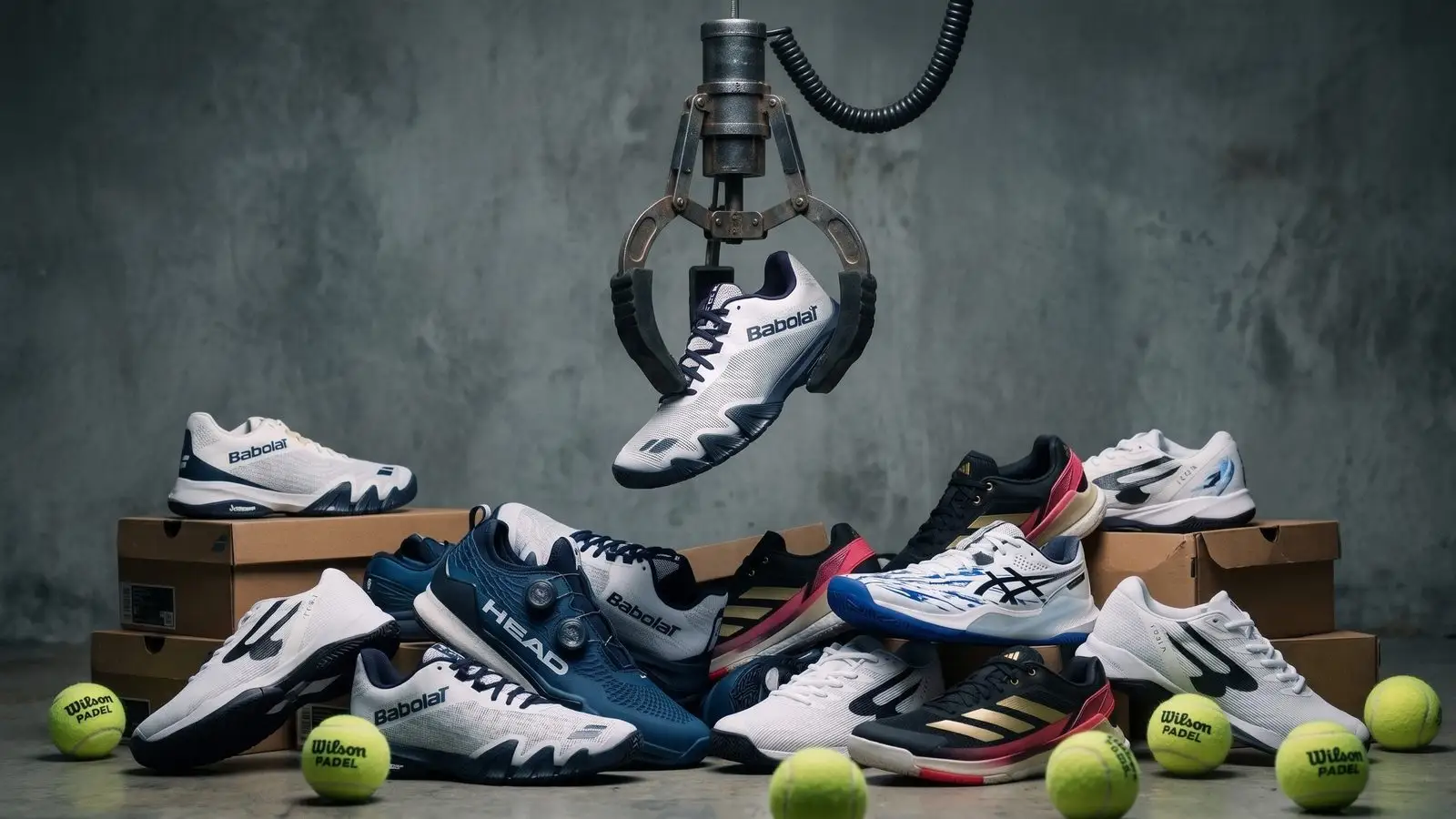
When you choose padel shoes (or padel trainers), start with the sole and the court you play on. A herringbone sole grips best on courts with lots of sand; an omni sole, covered in small studs, suits artificial grass with little sand. A hybrid sole mixes the two if you play at different clubs.
Why the sole matters so much
The rules of the International Padel Federation (FIP) allow courts made of concrete, wood, synthetic materials or artificial grass. On artificial grass, the amount of sand varies a lot from club to club.
Each sole behaves differently on each surface. Too little grip and you slide when you change direction. Too much, and your foot sticks to the court.
Brand and colour come later. Start with the court.
Herringbone, omni or hybrid: what is the difference?
- Herringbone (or “clay” sole). A zigzag pattern across the whole sole. It’s the pattern you find on clay-court tennis shoes, and the one that copes best with sand.
- Omni. Lots of small studs, like dots. It’s designed to grip on artificial grass with little sand.
- Hybrid. It combines herringbone zones and studded zones. Babolat sums up its padel sole like this: herringbone for the sand, studs for the grass.
Which sole for your court
| Your court | Sole | Why |
|---|---|---|
| Artificial grass with lots of sand | Herringbone | Bites into the sand |
| Artificial grass with little sand | Omni | The studs grip the grass |
| Several different clubs | Hybrid | Copes with both |
On concrete or other hard courts, we haven’t found a clear recommendation from the brands: check each shoe’s product page.
Not sure how much sand your court has? Notice how it feels underfoot and ask at your club. If there’s loose sand all over the court, count it as a lot.
What else to look for
- Stability. Padel is all sideways movement and sudden stops. Look for a shoe that holds your foot firmly at the sides.
- Cushioning. The more you play, the more you will notice it in how comfortable each match feels.
- Size. Try them on with the socks you play in: your foot shouldn’t move around inside the shoe. The shop lists EU sizes; check each brand’s size chart for the UK equivalent.
Padel shoes for different needs
These are pairs from PadelProShop’s English store, from cheapest to most expensive (prices checked on 23 October 2026). Prices are in euros, excluding delivery, and the code PUNTAZOS takes 10% off at checkout. See how to apply the code (video).
For beginners on a budget. The Asics Game FF Clay/OC, at €64.90, is light and flexible. It’s a tennis shoe that PadelProShop sells in its padel section. Asics markets it as an all-rounder, but the Clay/OC version has the sole for clay and omni courts (artificial grass with sand).
If you want stability. Babolat builds the Movea 2 around stability, support and cushioning, and recommends it for a more defensive game. It costs €89.00.
At a similar price there’s the Babolat Jet Tere 2 White/Port Royale, at €79.95 (down from €110; price on 23/10/2026). Its product page highlights a thicker midsole and a Michelin rubber outsole, but doesn’t say which tread pattern it uses: check the sole photos.
Copy code and shop at PadelProShop
If you play on different courts. The sole of the Nox Nerbo 2026 combines herringbone and studs. It also has a lateral reinforcement that gives you a wider base when you move sideways. It costs €109.90.
Available sizes change quickly, so check yours on each product page before you decide. With your feet sorted, the next step is the racket: our pick of the best padel rackets under €100 covers eight 2026 models by level and shape.
Frequently asked questions
Can you play padel in tennis shoes?
Yes, if they have a herringbone sole, like clay-court shoes. What you should avoid is running shoes: they aren’t built for the sideways movement padel demands.
Which sole is best for artificial grass?
It depends on how much sand there is. Lots of sand: herringbone. Little sand: omni. If you play at different clubs, a hybrid sole is the most versatile.
Are cheap padel shoes worth it?
Yes, if the sole suits your court and the shoe holds your foot well. If you play several times a week, it’s worth paying more for cushioning and stability.
Sources and topics
Sources (8)
- FIP: Reglas del Pádel, rules in force from 01/01/2026 (“Suelo” section, on the playing surface), in Spanish (accessed 20/10/2026; our translation)
- Babolat: padel shoes and their sole, Babolat’s official website (accessed 20/10/2026)
- Babolat: how to choose padel shoes (Movea 2), Babolat’s official website (accessed 20/10/2026)
- Asics: GAME FF CLAY/OC product page, Asics’s official website (accessed 20/10/2026)
- PadelProShop (English store): Asics Game FF Clay/OC (checked 23/10/2026)
- PadelProShop (English store): Babolat Movea 2 Dark Blue/Chili Red (checked 23/10/2026)
- PadelProShop (English store): Babolat Jet Tere 2 White/Port Royale (checked 23/10/2026)
- PadelProShop (English store): Nox Nerbo White/Gum Rubber 2026 (checked 23/10/2026)
More news


Weekly newsletter
The week in padel, without the filler
The padel news that mattered this week, picked for a five-minute email. Free. For now the newsletter is written in Spanish.
No spam. Unsubscribe whenever you like. Privacy.